Roll Out SPF, DKIM and DMARC Without Blocking Legitimate Mail
SPF, DKIM and DMARC address different parts of business email authentication. SPF publishes which systems may use a domain in an SMTP identity, DKIM adds a cryptographic signature, and DMARC checks whether the domain visible in the From field aligns with a successful SPF or DKIM identity. An “SPF pass” alone therefore does not necessarily produce a DMARC pass.
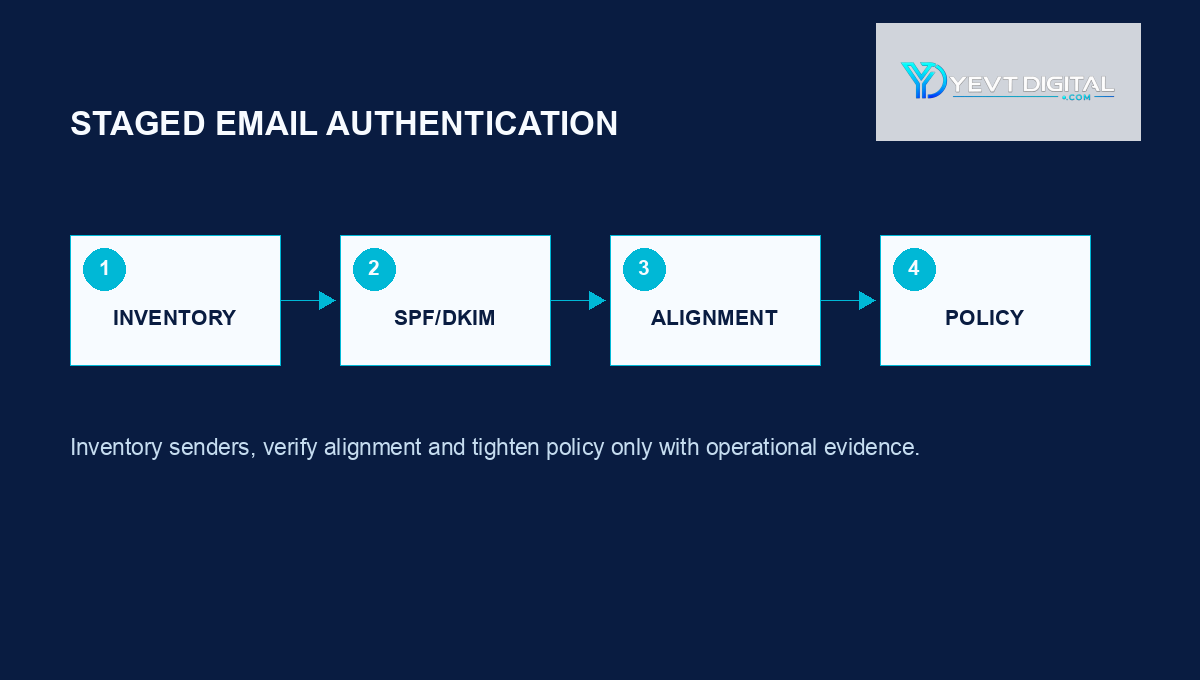
The largest operational risk is not merely a malformed DNS record. Enforcing a strict policy before inventorying legitimate senders can affect invoicing, CRM, support, website forms or vendors. The current DMARC standard is RFC 9989, published in May 2026. A controlled rollout begins with evidence about real sources, adds authentication and alignment, observes reports, and only then tightens policy in stages.
1. Inventory every legitimate mail source
Build the inventory before changing policy. Include employee mailboxes, web applications, contact forms, CRM, invoicing, support, marketing platforms, devices and vendors. Record each owner, visible From domain, SMTP MAIL FROM domain, DKIM d= domain, provider and evidence that the flow is still used.
Do not assume one provider means one identity. Transactional and marketing streams may use different return domains or selectors. Review subdomains and occasional senders that may disappear from a short sample.
Employees
Visible From: Business domain
MAIL FROM / SPF: Mail provider
DKIM d= / selector: Domain signature
Application
Visible From: Domain or subdomain
MAIL FROM / SPF: Return domain
DKIM d= / selector: Application signature
CRM / marketing
Visible From: Approved domain
MAIL FROM / SPF: Platform domain
DKIM d= / selector: Configured DKIM
Vendor
Visible From: Approved sender
MAIL FROM / SPF: Documented flow
DKIM d= / selector: Owner and test
2. Deploy SPF as an SMTP identity control
SPF lets a domain owner publish which IP addresses or systems may use that domain in the MAIL FROM or HELO identity. It does not authenticate the content of the visible From field. For DMARC, a successful SPF result matters when its authenticated domain aligns with the author domain.
Publish one valid SPF record for a domain and include documented sources. Check DNS syntax and RFC 7208 processing limits; long include and redirect chains can cause evaluation errors. Do not paste a generic record or remove a source without confirmation from the flow owner.
3. Configure DKIM signing and key ownership
DKIM signs selected headers and the body with a private key, while the public key is published in DNS under a selector. A receiver verifies that signed parts were not altered and that the signature is associated with the d= domain. DKIM alone does not decide whether a message is wanted.
Confirm that every service signs outbound messages and identify its d= domain. Record the selector owner, rotation procedure and compromised-key revocation path. Test rotation on a controlled sample and monitor the provider-supported transition.
4. Verify DMARC alignment, not isolated pass results
DMARC takes the author domain from the visible From field and checks alignment with an authenticated SPF or DKIM domain. DMARC passes when at least one mechanism succeeds and its domain aligns under the selected mode. An unrelated SPF pass is insufficient, as is a valid DKIM signature from a non-aligned domain.
Test representative messages from every source and retain redacted headers. Record which mechanism supplies alignment and what happens during forwarding or modification. Mailing lists and intermediaries may change the path, so assess real traffic.
5. Begin with observation and validate reports
Publish a DMARC record with an aggregate-report destination the team can securely process. The initial policy should support observation without intentionally requesting rejection while legitimate and unknown flows are identified. Receiver behaviour also depends on local policy, so no setting guarantees delivery.
Analyse reports by source, authenticated domain, alignment and disposition. Do not classify every unknown address as malicious or every familiar name as correct. Connect each finding to a system owner and a test message.
6. Tighten policy in stages with a rollback plan
Before stricter handling, require evidence that important legitimate flows are inventoried and aligned, reports arrive and a problem-reporting channel exists. Tighten in controlled steps; no universal percentage or number of days guarantees safety. Decide separately how subdomains are covered.
Before each change, preserve the previous DNS record, timestamp, owner, reason, expected result and rollback condition. After propagation, check public DNS, send controlled messages through critical flows and watch reports. Restore the previous known configuration if legitimate mail starts failing.
- Inventory every legitimate sender and identity.
- Authorise documented sources through SPF.
- Enable DKIM and assign key ownership.
- Confirm alignment with the visible From domain.
- Monitor aggregate reports and unknown flows.
- Tighten gradually with a tested rollback.
7. Frequently asked questions
Does SPF protect the visible From field?
Not directly. SPF authenticates an SMTP identity; for DMARC, that domain must align with the author domain.
Is DKIM enough for DMARC?
It can be when DKIM succeeds and the d= domain aligns with From, but every legitimate stream still needs review.
What is the current DMARC standard?
RFC 9989, published in May 2026, supersedes RFC 7489 as the current specification.
Does an observation-oriented policy guarantee delivery?
No. Receivers also apply local policies and messages may fail other checks.
When should policy become stricter?
After important sources are inventoried, aligned and tested, reports are monitored and rollback is ready.
What about forwarding and mailing lists?
They may change the SPF path or signed content. Test real flows and the aligned mechanism that survives the route.
8. Conclusion
A reliable SPF, DKIM and DMARC rollout starts with inventory, not enforcement. Authorise real sources, enable signing, verify alignment with the visible From domain and use reports to expose gaps. Every stricter step needs an owner, a legitimate-mail check and a documented rollback.
Sources: RFC 7208: Sender Policy Framework (SPF), RFC 6376: DomainKeys Identified Mail (DKIM), RFC 9989: DMARC. Accessed 23 November 2026.
Send the domain and sending-service inventory for a review of the authentication rollout plan.