Renew TLS Certificates Reliably: Automation, Rehearsal and Monitoring
Automated TLS certificate renewal is not complete when a new certificate has merely been issued. Domain-control validation, issuance, download, installation on the correct service, configuration reload and external verification of the active certificate must all succeed for the public site to continue without warnings.
The ACME standard automates identifier-control proof, ordering and certificate download. RFC 9773 adds ACME Renewal Information, allowing a server to suggest a renewal window. The local team still owns scheduling, deployment, monitoring and manual recovery. The decisive evidence is not “renewal succeeded” but the certificate served by the real public endpoint for the expected hostname.
1. Inventory names, certificates and deployment targets
For each public endpoint, record the hostname, issuer, ACME account or client, validation method, deployment target and alarm owner. Include redirects, alternative names, CDN or load-balancer edges, standby entries and services with separate renewal paths.
The inventory must answer two different questions: which certificate was issued and which certificate users currently see. A file may be new while a process still serves an old in-memory certificate or another node remains unchanged.
| Control | Record | Evidence |
|---|---|---|
| Identity | Hostname and alternative names | Every expected name is covered |
| Validation | HTTP, DNS or other ACME method | Challenge is reachable by the client |
| Deployment | Service, node and path | New version is loaded |
| Monitoring | External endpoint, threshold and owner | Active certificate is verifiable |
2. Understand the full ACME flow and dependencies
An ACME client creates an order, satisfies an approved identifier-control challenge, finalises the request and downloads the issued certificate. Each phase depends on DNS, network reachability, permissions, system time, issuer account state and allowed validation methods.
Wildcard and ordinary names may require different challenges. A DNS provider, firewall, proxy rule or permission change can break renewal even when the previous cycle succeeded. Keep dependencies in the inventory rather than one administrator’s memory.
3. Automate renewal and deployment with narrow privileges
The client should run unattended in the planned environment with only the permissions required for validation and deployment. Limit DNS-validation credentials to the necessary zone and operations where the provider supports that scope. Never expose them in logs or public scripts.
When supported, ARI lets the client use the ACME server’s suggested renewal window. Do not assume a universal lead time or certificate lifetime. Local scheduling must leave enough time for retries, investigation and manual recovery in the actual infrastructure.
4. Rehearse before the deadline becomes urgent
Use the test or staging mode documented by the specific client and issuer without replacing the valid production certificate. The rehearsal should exercise account access, validation, permissions and post-deployment hooks to the safe extent supported.
A successful rehearsal does not guarantee future issuance, but it reveals many changes before expiry. Record the time, client, target, result and limitations. Avoid unnecessary production orders and follow the issuer’s documented rate limits.
5. Verify the certificate that is actually live
After deployment, confirm that the service reloaded its configuration successfully. From an external vantage point, connect to every expected hostname with SNI and inspect identity, chain, validity interval and issuer. Check multiple endpoints when traffic spans nodes or regions.
Keep three states distinct: issued, installed and served publicly. Only the last one proves the user path. If nodes serve different versions, do not close the incident until distribution is reconciled.
6. Monitor independently of the renewal mechanism
An alert emitted by the same process that schedules renewal can disappear with that process. Add an independent external check for expiry and identity, plus evidence that the automated job ran. Thresholds and frequency should reflect local recovery time rather than a universal number of days.
Every alert needs an owner, a monitored channel and escalation. Include the endpoint, active expiry, last successful cycle and runbook location. Test the alert path in a controlled way without endangering the production certificate.
7. Document manual recovery and closure evidence
The recovery procedure should identify account access, validation repair, a safe renewal action, deployment location, service checks and escalation. Do not assume an administrator will remember details under pressure.
After each cycle, preserve the certificate identity, external verification time, covered names and result for all targeted nodes. Review the inventory periodically and remove retired names only after traffic and business dependencies are confirmed absent.
- Inventory every name, certificate, node and owner.
- Verify ACME validation paths and dependencies.
- Automate renewal and deployment with narrow privileges.
- Run a documented rehearsal before urgency.
- Externally verify the active certificate on every endpoint.
- Monitor expiry independently and maintain manual recovery.
7. Frequently asked questions
Does successful ACME renewal prove the website is safe?
Not necessarily. The new certificate must be deployed, loaded and externally confirmed on the real endpoint.
How many days before expiry should renewal run?
There is no universal number. Use issuer guidance, ARI when supported and the recovery time required by your infrastructure.
Does a wildcard certificate require DNS validation?
ACME validation depends on the identifier and issuer policy; check the specific service and client documentation.
Why is a service reload needed?
Many processes retain a certificate in memory. A new file is not active until the service loads it through a supported action.
Is inspecting the local file sufficient?
No. External verification shows what users receive through SNI, proxies, load balancers and all nodes.
What happens if automation fails?
The alert should trigger a documented manual recovery covering validation, deployment and external confirmation.
8. Conclusion
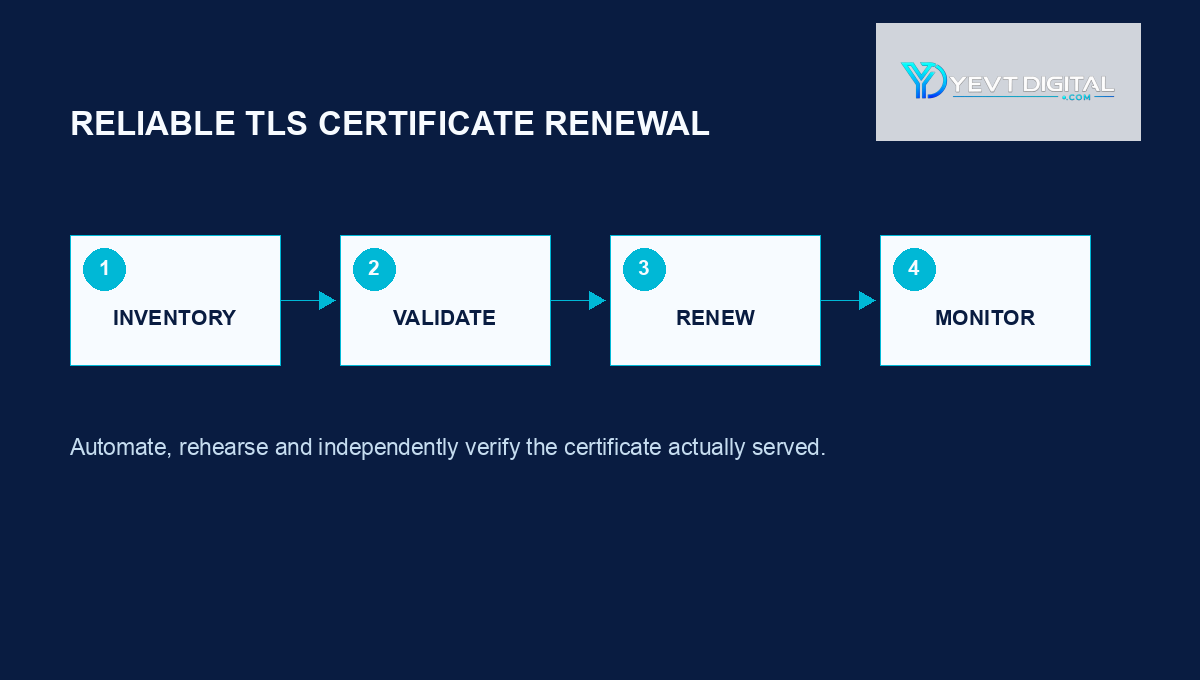
Reliable TLS certificate renewal is a chain, not one task. Inventory endpoints, verify ACME dependencies, automate with narrow privileges, rehearse and externally confirm the certificate that is actually live. Independent monitoring and manual recovery give the team time to respond before users see an error.
Sources: RFC 8555: Automatic Certificate Management Environment, RFC 9773: ACME Renewal Information, Let’s Encrypt: Integration Guide. Accessed 22 November 2026.
Send the domain inventory and current renewal flow for a review of critical points and monitoring.