Plan a DNS Change: TTL, Verification and Rollback
A DNS change may alter one record, yet its effect travels through authoritative servers, recursive resolvers, local caches and applications. If a team changes the target without an inventory, an earlier TTL reduction and a rollback plan, some users may remain on the old address while others already see the new one.
TTL is not a universal propagation countdown. It tells a resolver how long it may cache the received answer. AWS Route 53 recommends temporarily lowering TTL before a critical change, waiting for the former value to expire, monitoring the result and raising TTL after stability. Exact values, cost and procedure depend on the DNS provider and the risk of the change.
1. Inventory the exact records, dependencies and owners
Export or record the active zone before editing. For every affected record, preserve the name, type, current value, TTL, proposed value and reason. Include CNAME chains, addresses behind A or AAAA records, verification TXT records and services that depend on the same hostname.
Name the operator, the person who validates the new service and the person authorised to approve rollback. Keep the old value available through the observation period. A zone snapshot is insufficient if nobody knows which records to restore and in what order.
| Item | Before the change | Planned evidence |
|---|---|---|
| Record | Name, type, value and TTL | Authoritative answer matches the plan |
| Dependency | Application, CDN, certificate or mail | Service works at the new target |
| Rollback | Old value and owner | Command or procedure is ready |
| Monitoring | Metric, threshold and duration | Decision to continue or roll back |
2. Understand TTL and the path through caches
The authoritative server publishes data and its TTL. A recursive resolver may return the cached answer until that period expires. Lowering TTL later does not shorten an answer already stored with the old, longer value.
Negative answers can also be cached. RFC 2308 specifies caching for responses that a name or record type does not exist. If a new hostname is queried too early and returns NXDOMAIN, that result may remain cached under the zone’s rules. The plan must account for names that did not previously exist.
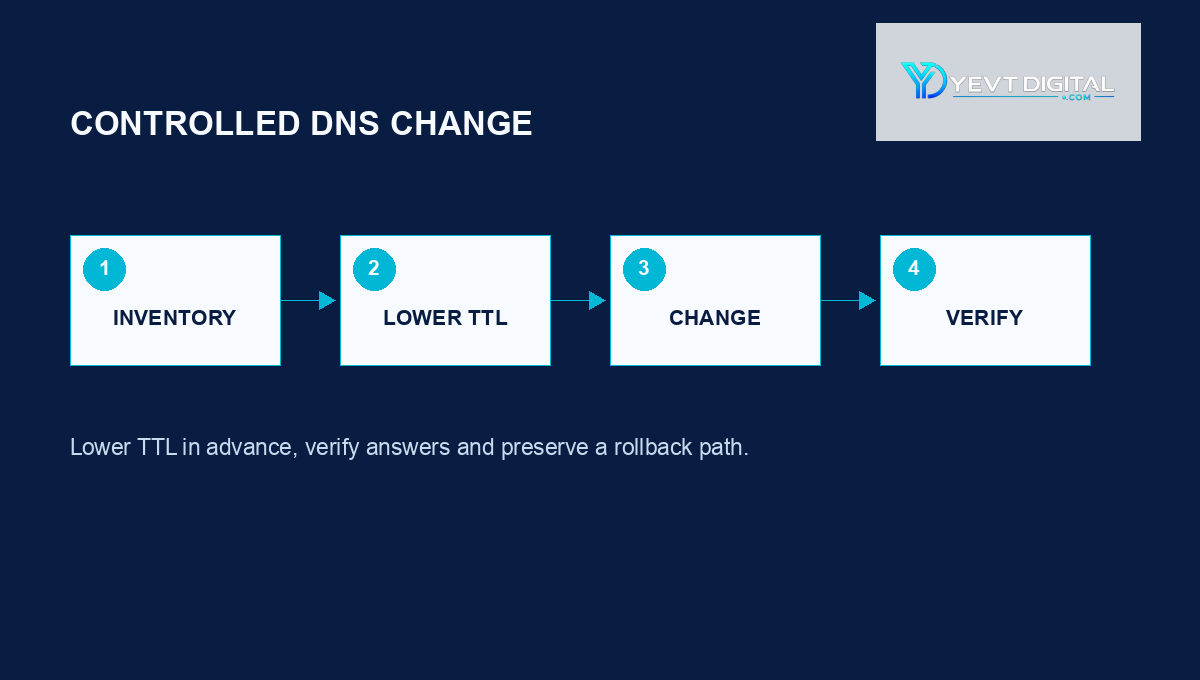
3. Lower TTL in advance and wait out the former value
Lower TTL only for records that will change, early enough for resolvers to receive the shorter value before cutover. Then wait at least the previous TTL from the point when the shorter value became authoritative. If delegation changes, inspect relevant parent-zone TTLs as well.
A shorter TTL enables faster refreshes but increases query volume and may affect cost or load. Do not apply one value to every system. Record the reason, duration and moment when the normal TTL will be restored.
4. Change the smallest set and preserve the old target
Apply the reviewed change to the smallest necessary record set. Avoid changing DNS, application configuration, CDN and certificates simultaneously when that would obscure the cause of a failure. Preserve the change identity, time and provider control-plane response.
A provider status such as accepted or synchronised is not evidence that every public resolver has refreshed its cache. Keep the old target operational during observation unless retaining it presents a separately assessed security risk.
5. Verify authoritative answers and the actual service
Query each authoritative server first and confirm the exact value, type and expected TTL. Then inspect several independent public resolvers and, when justified, different networks. Record the actual answer and time; a green dashboard without DNS evidence is not sufficient.
Verify the service as well: HTTP response and content, TLS certificate and hostname, key application functions and relevant logs. For an MX change, inspect DNS and configuration without sending messages to real recipients unless that test is separately authorised. Distinguish a DNS fault from an application fault at the new target.
6. Bind rollback to a threshold, then restore TTL
Define rollback criteria before the change: for example, a critical path unavailable, a mismatched certificate or an agreed error threshold. Name the decision owner and observation period. Without criteria, a team may wait too long or reverse the change because of one unrepresentative cache.
If rollback is required, restore only the documented old values, repeat authoritative and public checks and preserve the result. When the new route remains stable for the planned period, restore the normal TTL. Retire the old target later under a separate approved plan.
- Preserve the zone inventory, dependencies and old values.
- Lower the relevant TTL early enough.
- Wait for the former TTL to expire.
- Change the smallest necessary record set.
- Verify authoritative answers, resolvers and the service.
- Roll back at the defined threshold or restore TTL after stability.
7. Frequently asked questions
Does TTL determine how long a change takes everywhere?
No. TTL limits a particular cached answer; resolvers and the time of their last query differ.
Does lowering TTL after the change help immediately?
Not for answers already cached under the former value. Lower it in advance and wait out the old interval.
What is negative caching?
Caching an answer that a name or record type does not exist. It can affect a new hostname queried before its record was added.
Is provider status sufficient evidence?
No. Check authoritative answers, independent resolvers and the service itself.
When should normal TTL return?
After the documented stability window and completed checks, according to the system’s policy.
Does DNS rollback immediately return every user?
Not necessarily. Cached new answers may remain until their TTL expires, so rollback also requires monitoring.
8. Conclusion
A controlled DNS change begins before a record is edited. Inventory the zone and dependencies, lower TTL in advance, wait out the former interval, change the smallest set and verify both DNS and the application. The old target, a rollback threshold and evidence from multiple sources turn uncertain waiting into an operational process.
Sources: AWS Route 53: DNS best practices, AWS Route 53: migrating DNS for an active domain, RFC 2308: Negative Caching of DNS Queries. Accessed 21 November 2026.
Send the domain and proposed change for a review of DNS dependencies and rollback planning.